The Next Leap in Travel Speed - Space
By Prasad Kunisetty
For decades, commercial air travel became safer, cheaper, more efficient, and more accessible. But in one important area, we actually moved backward: speed.
Concorde showed the world what supersonic passenger travel could look like. It could cruise at about Mach 2.04 and fly London to New York in roughly three hours, compared with about seven to eight hours on conventional aircraft. But Concorde was expensive to operate, noisy, limited in routes, and was retired in 2003. Since then, long-haul passenger travel has remained largely subsonic.
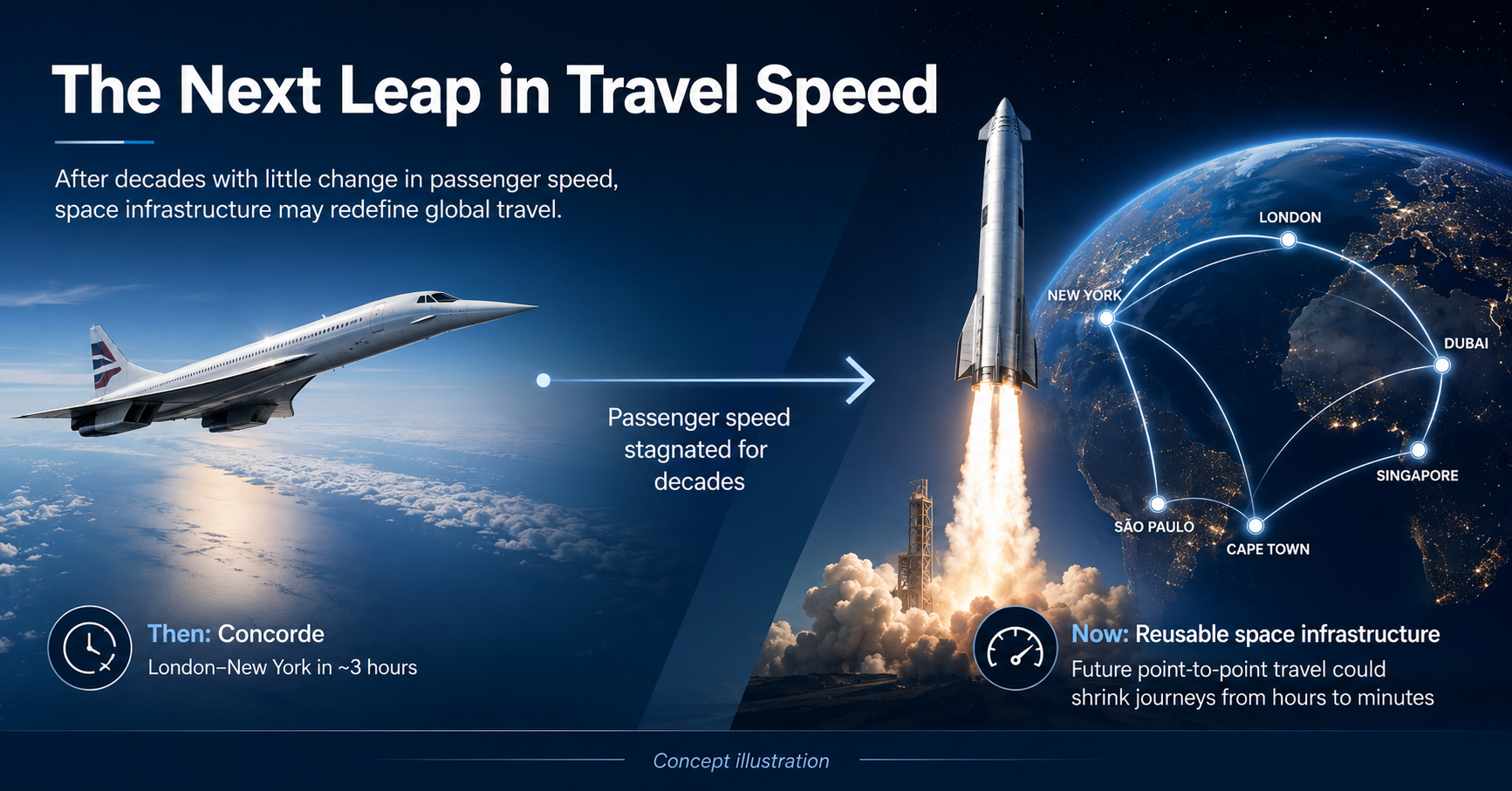
Now, a new race is emerging. This time, it may not be led by traditional aircraft manufacturers alone, but by companies building space infrastructure.
SpaceX is the clear front-runner. Reuters recently reported that SpaceX has spent more than $15 billion developing Starship, its next-generation fully reusable rocket system. The goal is not just Mars or the Moon. The deeper story is reusable, high-frequency launch infrastructure that could eventually make space access more like an airline schedule.
Virgin Galactic has also explored high-speed commercial travel concepts. In 2020, it unveiled a Mach 3 aircraft concept designed to carry 9 to 19 passengers at altitudes above 60,000 feet, with Rolls-Royce involved in propulsion discussions.
If these technologies mature, the future of travel could look very different. SpaceX has previously described an 'Earth-to-Earth' concept where many long-distance trips could be completed in under an hour, with some routes taking around 30 minutes.
That does not mean New York to India will be a 10-minute trip tomorrow. Safety, regulation, launch infrastructure, cost, noise, insurance, and public acceptance are massive challenges. But the direction is clear: the next major leap in global travel speed may come not from flying higher in the atmosphere, but from briefly leaving it.
The bigger question is this:
Are we at the beginning of a new transportation era, where 'international travel' becomes measured not in hours, but in minutes?
News Posted: 20 May, 2026
|