Nirmala Sitharaman presents Yuva Shakti-driven Union Budget 2026-27
₹10,000 crore SME Growth Fund proposed to create future Champions
Visakhapatnam: Union Minister for Finance and Corporate Affairs, Smt Nirmala Sitharaman presented the Union Budget 2026-2027 in Parliament today.
Presenting the Yuva Shakti-driven Budget which emphasises on Government's 'Sankalp' to focus on poor, underprivileged and the disadvantaged, the Finance Minister said, India will continue to take confident steps towards Viksit Bharat, balancing ambition with inclusion.
She said that any foreign company that provides cloud services to customers globally by using data centre services from India will be provided tax holiday till 2047. She added that a safe harbour of 15 percent on cost is to be provided if the company providing data centre services from India is a related entity.
To develop India as a global Biopharma manufacturing hub, the Biopharma SHAKTI with an outlay of ₹ 10,000 crores to build the ecosystem for domestic production of biologics and biosimilars will be set up over the next 5 years. The Strategy will include a Biopharma-focused network with 3 new National Institutes of Pharmaceutical Education and Research (NIPER) and upgrading 7 existing ones. It will also create a network of over 1000 accredited India Clinical Trials sites.
For the labour-intensive Textile Sector, an Integrated Programme with 5 sub-parts was proposed: The National Fibre Scheme for self-reliance in natural fibres such as silk, wool and jute, man-made fibres, and new-age fibres; Textile Expansion and Employment Scheme to modernise traditional clusters with capital support for machinery, technology upgradation and common testing and certification centres.
Recognising MSMEs as a vital engine of growth, a dedicated ₹10,000 crore SME Growth Fund was proposed to create future Champions, incentivizing enterprises based on select criteria.
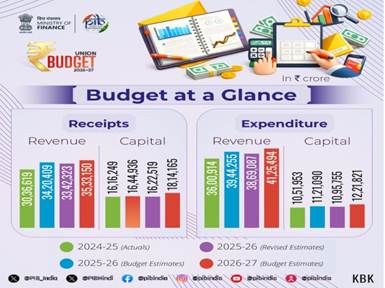
The Finance Minister said, Public capex has increased manifold from ₹2 lakh crore in FY2014-15 to an allocation of ₹11.2 lakh crore in BE 2025-26. In FY2026-27, she proposed to increase it to ₹12.2 lakh crore to continue the momentum.
The Budget aims to further amplify the potential of cities to deliver the economic power of agglomerations by mapping city economic regions (CER), based on their specific growth drivers. An allocation of ₹ 5000 crore per CER over 5 years is proposed for implementing their plans through a challenge mode with a reform-cum-results based financing mechanism.
To promote India as a hub for medical tourism services, the Finance Minister proposed a scheme to support States in establishing five Regional Medical Hubs, in partnership with the private sector. These Hubs will serve as integrated healthcare complexes that combine medical, educational and research facilities. They will have AYUSH Centres, Medical Value Tourism Facilitation Centres and infrastructure for diagnostics, post-care and rehabilitation.
India's Animation, Visual Effects, Gaming and Comics (AVGC) sector is a growing industry, projected to require 2 million professionals by 2030. The Finance Minister proposed to support the Indian Institute of Creative Technologies, Mumbai in setting up AVGC Content Creator Labs in 15,000 secondary schools and 500 colleges.
In Higher Education STEM institutions, prolonged hours of study and laboratory work pose some challenges for girl students. Through VGF/capital support, 1 girls hostel will be established in every district.
Taking forward the systematic nurturing of sports talent which is set in motion through the Khelo India programme, the Finance Minister proposed to launch a Khelo India Mission to transform the Sports sector over the next decade.
The Finance Minister proposed Bharat-VISTAAR (Virtually Integrated System to Access Agricultural Resources), a multilingual AI tool that shall integrate the AgriStack portals and the ICAR package on agricultural practices with AI systems. This will enhance farm productivity, enable better decisions for farmers and reduce risk by providing customised advisory support.
She further proposed the development of an integrated East Coast Industrial Corridor with a well-connected node at Durgapur, creation of 5 tourism destinations in the 5 Purvodaya States, and the provision of 4,000 e-buses. She also proposed to launch a Scheme for Development of Buddhist Circuits in Arunachal Pradesh, Sikkim, Assam, Manipur, Mizoram and Tripura.
The debt-to-GDP ratio is estimated to be 55.6 percent of GDP in BE 2026-27, compared to 56.1 percent of GDP in RE 2025-26. A declining debt-to-GDP ratio will gradually free up resources for priority sector expenditure by reducing the outgo on interest payments. In RE 2025-26, the fiscal deficit has been estimated at par with BE of 2025-26 at 4.4 percent of GDP. In line with the new fiscal prudence path of debt consolidation, the fiscal deficit in BE 2026-27 is estimated to be 4.3 percent of GDP.
In Direct Taxes, many new reforms are proposed in the Union Budget 2026-27. The New Income tax Act, 2025 will come into effect from April 2026.
The Overseas tour program package is reduced from the current 5 percent and 20 percent to 2 percent without any stipulation of amount. Further, TCS for pursuing education and for medical purposes under the Liberalized Remittance Scheme (LRS) reduced from 5 percent to 2 percent.
It is also proposed that the supply of manpower services to be brought within the ambit of payment to contractors for the purpose of TDS. TDS on these services will be at the rate of either 1 percent or 2 percent only.
For small taxpayers, a rule-based automated process will enable obtaining a lower or nil deduction certificate instead of filing an application with the assessing officer. Also, the time available for revising returns is proposed to be extended from 31st December to up to 31st March with the payment of a nominal fee. Further, the timeline for filing of tax returns is to be staggered.
To address practical issues of small taxpayers, a One-time 6-month foreign asset disclosure scheme for students, young professionals, tech employees, relocated NRIs, and such others to be introduced to disclose income or assets below a certain size.
Underscoring the significance of the IT sector for India's growth trajectory, the Budget proposes to club software development services, IT enabled services, knowledge process outsourcing services and contract R&D services relating to software development under a single category of Information Technology Services with a common safe harbour margin of 15.5 percent.
Unilateral Advanced Pricing Agreement (APA) process for IT services is proposed to be fast-tracked with an endeavour to conclude it within two years, which can be extended by 6 months on taxpayer's request.
The Budget proposes to provide exemption from income tax for 5 years to any non-resident who provides capital goods, equipment or tooling, to any toll manufacturer in a bonded zone.
News Posted: 1 February, 2026
|